Development of an Artificial Intelligence–Enabled Early Detection System for Emerging Human Pathogens under the National One Health Mission IN INDIA
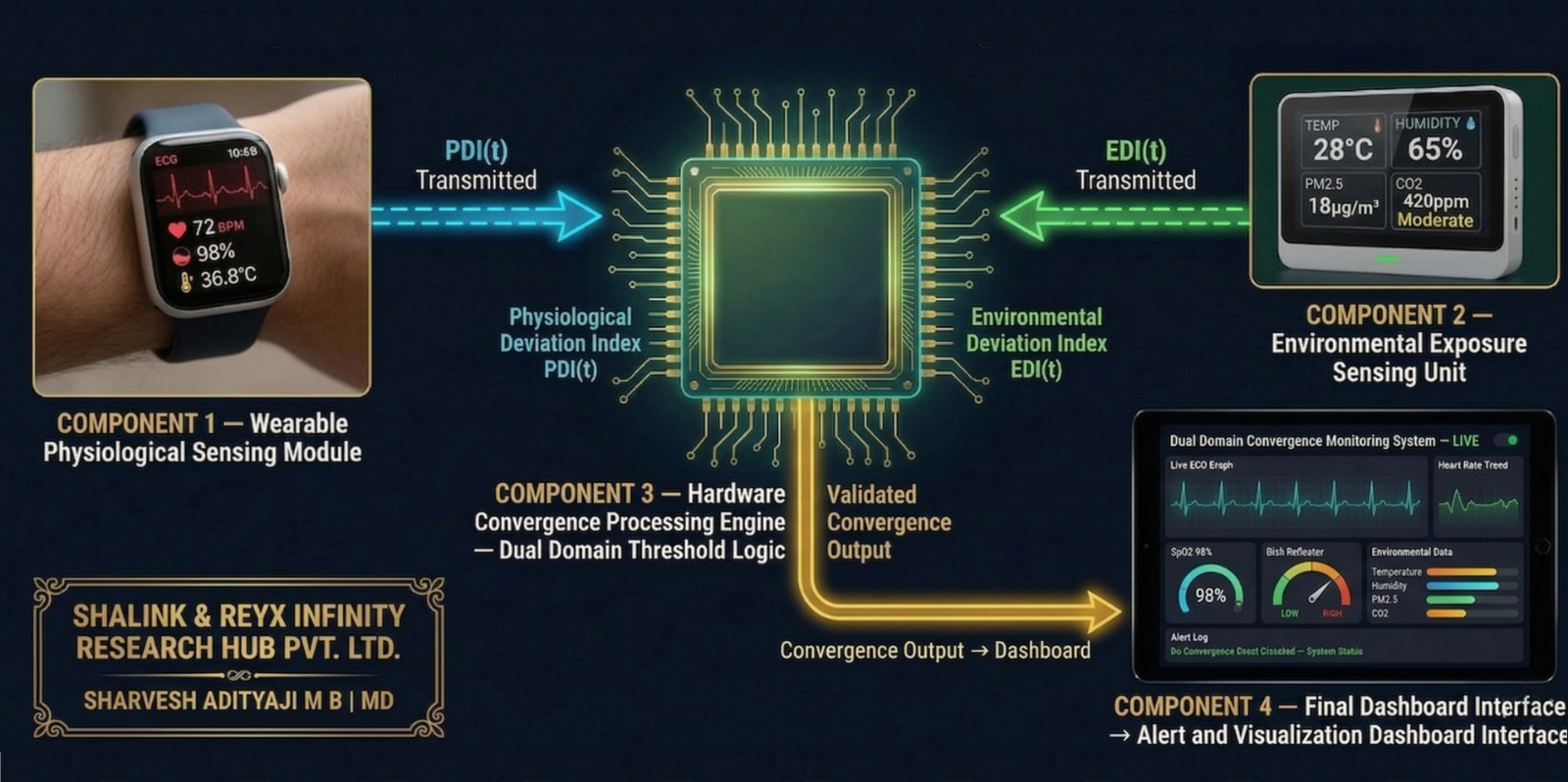 Research Area:-
- AI-Enabled Early Detection of Emerging Human Infectious Diseases
- Syndromic Surveillance through Non-Invasive Physiological Signal Monitoring
- Host-Response Analytics and Pre-Symptomatic Risk Identification
- Explainable Artificial Intelligence (XAI) for Public Health Decision Support
- One Health–Aligned Digital Surveillance Systems
- Wearable-Based Health Monitoring and Anomaly Detection
- Secure mHealth and Cloud-Integrated Surveillance Architectures
- Federated and Privacy-Preserving AI for Population-Level Health Monitoring
- Integration with National Public Health Surveillance and IHR-Compliant Systems
Team / Leads
 Sharvesh Adityaji M B
Innovator & Co-Principle Investigator
Shalink & ReyX Infinity Research Hub Pvt. Ltd.
Highlights / Description (Accurate, Referenced):
Novelty:
Develops a non-invasive, AI-enabled early warning system that detects pre-symptomatic physiological anomalies associated with emerging human infections. Instead of relying on pathogen-specific diagnostics, the platform analyzes host-response signals using machine learning and explainable AI to generate early risk alerts, supporting proactive public health surveillance under the One Health framework.
Key Features:-
- Uses non-invasive physiological indicators (e.g., heart rate variability, oxygen saturation, activity and sleep patterns) for anomaly detection.
- Applies supervised and unsupervised machine learning models to classify health deviations as Normal or Risk-Flagged.
- Incorporates Explainable AI (XAI) to provide transparent reasoning for each risk alert.
- Device-agnostic architecture compatible with wearable and mobile health platforms.
- Designed for integration with public health surveillance systems under the National One Health Mission.


Advantages:-
- Pathogen-agnostic framework capable of detecting emerging or novel infectious threats.
- Supports early risk identification before overt clinical symptoms appear.
- Reduces dependency on immediate laboratory diagnostics in early outbreak phases.
- Strengthens outbreak preparedness and community-level syndromic surveillance.
- Aligned with National One Health Mission objectives and WHO IHR surveillance principles.
Practical Benefits:-
- Non-invasive and infrastructure-light deployment suitable for large-scale public health use.
- Scalable from pilot institutions to district, state, and national surveillance networks.
- Privacy-conscious architecture designed for ethical AI use and secure data handling.
- Adaptable for use in hospitals, community health centers, and institutional monitoring systems.